
Know exactly why the room was bad.
When an executive says the call was awful, guessing is not an answer. CrossRoom reconstructs the meeting minute by minute across the whole room stack, pins each impairment to one layer, and names the exact device and the exact fix.
Read-only and advise-only. It never drives a display, a DSP or a codec. And it never claims to have recorded your meeting: the replay is rebuilt from measured quality, and it says so on the screen.
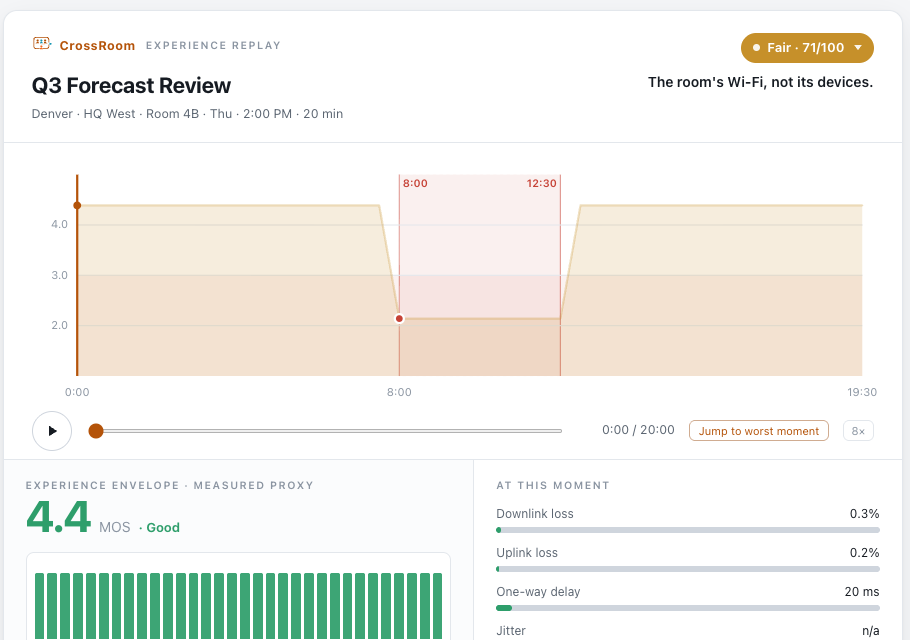
Experience Replay. What the people in that room would have heard, thirty seconds at a time.
The problem
The device was up. The meeting was still terrible.
An executive walks out of Room 4B and says the call was unusable. You go and look. The codec was online all morning, the switch logged no errors, and the platform dashboard is green. Every tool you own tells you nothing was wrong, and every person who was in that room tells you something was.
So the ticket gets closed as not reproducible, and next month it happens again, to the same person, in the same room.
The gap between "the device was up" and "the meeting was terrible" is the reason this product exists. Uptime was never the thing anyone cared about; it was just the only thing that was easy to measure.
Your first room
It reached that verdict because it could see the radio. What happens when it cannot?
The Wi-Fi answer you just watched was high confidence for one reason: the room’s radio metrics were being collected, so the engine could correlate the loss against a weak signal and a roam. Take those away and a lesser tool still says Wi-Fi, because Wi-Fi is the satisfying answer. CrossRoom does something else.
What it handed back for the Q3 Forecast Review
- What
- The audio in both directions degraded to MOS 2.1 (pooled MOS 3.3 for the meeting).
- When
- Worst sustained span started at 8:00 and lasted 4 min 30 s.
- Where
- AP-3F-North (Denver · HQ West · Room 4B).
- Why
- Network, Wi-Fi, high confidence: bidirectional loss correlated with weak radio and AP roaming.
- Fix
- Move Room 4B’s codec off the Wi-Fi SSID onto the wired access VLAN at switch sw-4b-idf1, port Gi1/0/12. Verify by re-running a test call: bidirectional loss should fall below 1%. To roll back, reselect the previous Wi-Fi profile on the codec.
Nobody wrote that. The engine did, and every line of it is anchored to a measurement. Note what the fix is: a port number in a comms closet. That is a job, not a theory.
Every integration you connect makes the next verdict harder to dismiss. Read-only, no agents in the room, and nothing recorded: it reads the telemetry the codec, the DSP and the network are already emitting. You will start with rooms it can only half explain, and it will be candid about which half.
See it work
The meeting the CFO complained about.
A real reconstruction: the Q3 Forecast Review in Room 4B, a call where every device was healthy and the audio still fell apart.
Start here. You will open one bad meeting, scrub to the moment it broke, and read the verdict. It takes about a minute.
CrossRoom
meeting-quality forensics
Sample
One bad meeting, traced to one access point.
Every device in that room was healthy the whole time. It still found the Wi-Fi, named the access point, and gave you the fix.
Sample data, from a reconstructed meeting. CrossRoom never records your calls.
The limits
It was never in the room, and the replay says so.
That same rule reaches its floor here. Experience Replay is a reconstruction, built from the quality your gear measured while the call was running, and every screen that shows it says so. CrossRoom has no microphone in your boardroom and no copy of what anyone said, so a meeting that was never instrumented stays unsolved, and it tells you so rather than papering over the gap.
A ping tells you the device answered, and says nothing about what the room heard. That gap is the whole product. CrossRoom takes network signal and spends it on one job: attributing what the room heard to a cause. Your monitoring keeps its job, your ticketing keeps its job, and your codec keeps taking orders from you, never from CrossRoom.
The honesty rule
A number is only ever as good as the worst thing underneath it.
Every value in a CrossRoom report carries where it came from and how it was obtained, and anything derived from it inherits the weakest input beneath it. A measurement it never took is not a zero. A window with no samples produces no bar on the chart, rather than a flat line that looks like silence.
That is what makes the verdict something you can carry into a room with an angry executive. A tool that rounds an unknown up to green will embarrass you in front of one, exactly once.
How it works
Eleven layers, on one clock.
That candour only counts if the verdict underneath it holds up, so here is how it gets there. It lays every layer of the room on a single timeline, and a fault in one then shows up against exactly what the others were doing that second.
- It collects across vendors The network, the switch port, the codec, the microphones and DSP, the camera and USB peripherals, the wireless, the WAN circuit, the meeting platform and the room's own configuration. Eleven layers, gathered by nineteen collectors from 44 vendor integrations, and laid on one timeline. The network team's tool, the AV vendor's tool and the platform's tool each see one layer, and each concludes it was one of the other two. That is the argument you have been losing.
- It separates your end from theirs Not "the room had an issue at some point." What the room heard, in thirty-second slices, for the length of the call, and which participant's send was the one that was lossy.
- The score models the human Weighted by how long an impairment lasted and how much it mattered. Thirty seconds of garbled audio during the one thing that person needed to hear is not the same as a blip in the small talk, and the score knows the difference.
- The audio score is ITU-T G.107 The E-model is what carriers use to predict what a call sounded like, and CrossRoom runs the real one, with the codec impairment values published in G.113. G.113 predates Opus, so the Opus values are research-derived, and the code labels them that way.
- It blames one layer, and names the device Network, AV device, meeting platform, room configuration, or user error. With a confidence level. When the evidence does not support a verdict, it returns inconclusive. The most plausible culprit is not the same thing as the guilty one.
- Blast-radius correlation It answers the first question anyone asks. Was it just them, or was it the whole building?
Before you ask
The eight questions we get on the first call.
What access do you need?
Read-only. CrossRoom never drives a display, a DSP or a codec. It reads what the room and the call already reported.
Will it change anything?
No. Read-only and advise-only, in a room where a wrong write is somebody's meeting.
How long until I have something useful?
After the meeting that went badly. One call in, one reconstruction out, with no baseline period to sit through first.
Does this replace the tools I already run?
No. Your platform's dashboard already told you the call was fine, which is the problem. CrossRoom scores what the people in the room actually heard.
What happens when it is wrong?
It never claims to have recorded your meeting, and it says so on the screen. The replay is rebuilt from measured quality rather than captured audio. It blames one layer and names one device instead of handing you a list to work through.
Can I start with one bad meeting?
That is the unit. The call somebody escalated is the right first input.
What data leaves my environment?
Nothing. It binds to 127.0.0.1, reachable only from the machine you run it on.
Will it work in a restricted or air-gapped environment?
Yes. It is a desktop application with no service behind it and nothing to sign in to.
What happens next
Four steps, and you can stop after any of them.
- Install it on your laptop. A double-click launcher.
- Point it at the meeting that went wrong. The call somebody escalated, rather than a representative sample.
- It rebuilds the call thirty seconds at a time. And scores what the people in the room heard, rather than what the dashboard averaged.
- Take the one device it names. It blames a single layer and a single device, so there is one thing to go and check.
The buying unit is one room incident. One bad call, reconstructed. If the answer is the one nobody could get any other way, that is when a wider conversation makes sense.
Next time, have an answer.
Name a room and a date. It will tell you what the people in it heard, and who to call about it.